
Can a subtle quantum effect leave a pattern we can see in a particle detector? Our new study uses decades-old data from CERN’s DELPHI experiment to explore exactly that.
The data come from electron-positron collisions that produced Z bosons, short-lived particles that carry the weak force. When a Z boson decays, it can produce a shower of particles that fly through the detector.
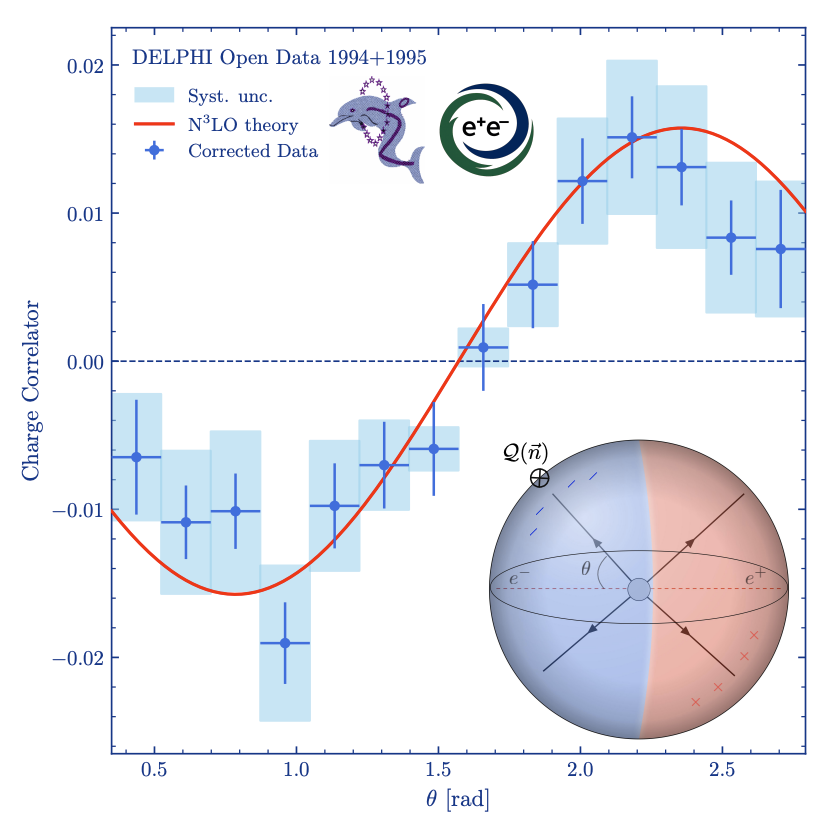
We studied where positive and negative electric charge went in these events. Averaged over many collisions, their distributions reveal a small but clear imbalance between the forward and backward directions.
This pattern connects to a feature of quantum physics called an anomaly. Here, “anomaly” is a technical term for a quantum effect predicted within the Standard Model, our current theory of fundamental particles and their interactions.
By measuring this charge pattern, we can connect an abstract property of the theory to something recorded by a real detector. The approach also offers a new way to test the Standard Model more precisely.
It’s exciting to find new ways to look at data collected more than thirty years ago!
Read the paper on arXiv, by Jingyu Zhang et al. For the accompanying analysis details, read the measurement paper and the analysis note.