
Overview
Quarks and gluons are the building blocks of protons, neutrons, and other strongly interacting particles. Their interactions produce a remarkable range of behavior—from the formation of individual particles to the collective motion of matter at extreme temperatures.
Our group studies the strong interaction through high-energy particle collisions. We use electron–positron collisions to examine how quarks and gluons become the particles we observe, and heavy ion collisions to investigate the hot, dense matter known as the quark–gluon plasma.
Connecting these measurements with theoretical calculations is central to our work. We develop analyses and statistical methods that bring different observations together, helping us determine which descriptions of the underlying physics are consistent with the data.
Electron–positron collisions
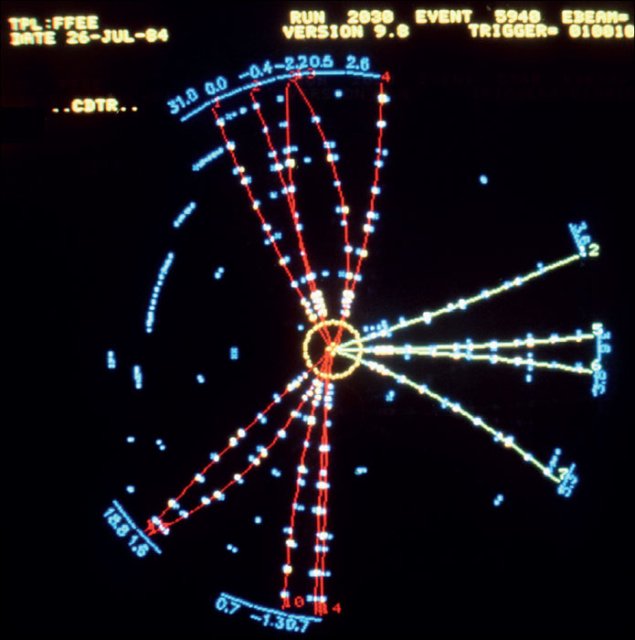
Electron–positron collisions provide a comparatively simple starting point for studying the strong interaction. Without the complex internal structure of colliding nuclei, they offer a setting in which we can examine how quarks and gluons radiate, form jets, and eventually become hadrons.
We revisit data recorded at the Large Electron–Positron Collider, including the ALEPH and DELPHI experiments, with new observables and modern analysis methods. Our interests include energy correlations, event shapes, identified particle production, and correlations between particles separated widely in angle.
These measurements help us investigate the transition from quarks and gluons to hadrons. They also provide a reference for understanding more complex collision systems. Making archived data usable for new questions—and preserving the knowledge needed to analyze them—is an important part of this effort.
Heavy ion collisions
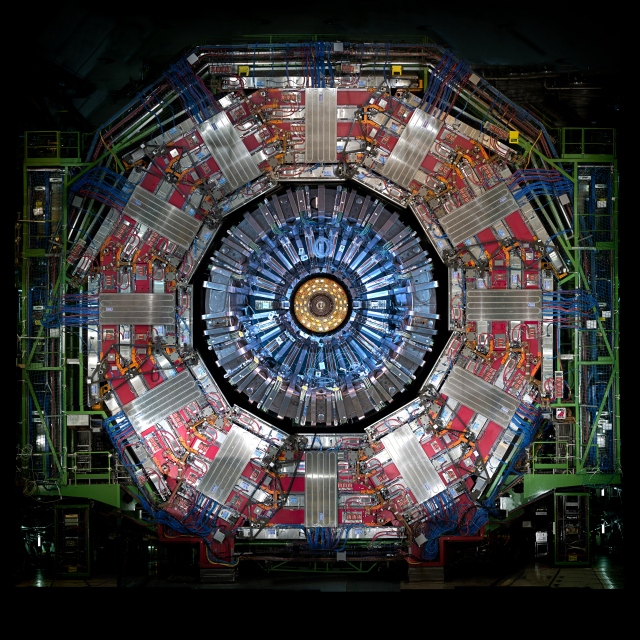
Colliding heavy nuclei at high energies creates matter hot enough for quarks and gluons to exist beyond the boundaries of individual protons and neutrons. This quark–gluon plasma gives us a way to study the strong interaction under conditions very different from those in ordinary matter.
Our group studies this medium through measurements with the CMS experiment at the Large Hadron Collider. We use energetic quarks and gluons, observed as particle jets, to investigate how energy moves through the plasma and how the surrounding matter responds.
Measurements involving photons and Z bosons provide additional information about the initial hard scattering. By comparing heavy ion collisions with proton collisions and other systems, we aim to understand which observed patterns arise from the medium and what they reveal about its properties.

Global parameter extraction
A single measurement rarely determines a property of nuclear matter on its own. Different observables respond to different aspects of the physics, and interpreting them requires theoretical models with their own assumptions and uncertainties.
We use Bayesian inference to connect measurements with model calculations and constrain the parameters that describe the underlying physics. Combining information from several observables can help distinguish between explanations that would look similar in a single measurement.
Our work includes studies of jet energy loss and the properties of the quark–gluon plasma within the JETSCAPE framework. We are interested both in the parameter constraints and in how reliably they can be interpreted: which measurements provide the information, how uncertainties affect the conclusions, and where a model succeeds or falls short.